
QCTO Accreditation & Transition
A complete guide to understanding, implementing, and managing QCTO accreditation and the transition from legacy qualifications to occupational qualifications within the PSET sector.
South Africa is undergoing a major transformation in its qualifications landscape. Legacy qualifications (unit standard‑based) are being phased out and replaced by Occupational Qualifications (curriculum‑based). This transition has created confusion for SETAs, Skills Development Providers, Employers, and learners. This pillar provides a clear, structured, and compliance‑aligned explanation of the QCTO system, accreditation processes, roles, responsibilities, and quality assurance requirements.
What this pillar covers
This pillar explains the full QCTO accreditation ecosystem, including:
The transition from legacy qualifications to occupational qualifications
QCTO accreditation requirements
Roles of SETAs, QCTO, SAQA, Providers, Employers, Learners
Quality assurance responsibilities
Curriculum structure of occupational qualifications
Compliance requirements
Certification processes
NQF structure and qualification placement
Common sector confusion and how to resolve it
Why QCTO Accreditation matters
The migration to occupational qualifications is one of the most significant changes in South Africa’s skills development system. Institutions that fail to transition will lose accreditation, funding opportunities, and the ability to train learners.
Compliance
QCTO accreditation is now the primary compliance requirement for Skills Development Providers.
Governance
Clear roles between SETAs and QCTO ensure quality assurance integrity and national standardisation.
Performance
Occupational qualifications improve workplace relevance, learner competence, and employer confidence.
Key Components
Legacy → Occupational Qualification Transition Understanding the phase‑out of unit standard‑based qualifications and the introduction of curriculum‑based occupational qualifications.
Occupational Qualification Structure Three components: Knowledge, Practical Skills, Workplace Experience.
QCTO Accreditation Requirements Provider accreditation, site approval, learning material alignment, workplace approval.
Quality Assurance Roles SETAs vs QCTO responsibilities.
Assessment & Certification External Integrated Summative Assessment (EISA) and QCTO certification.
NQF Placement How occupational qualifications fit into the National Qualifications Framework.
Compliance Requirements Policies, staff competence, facilities, workplace partnerships, assessment systems.
Stakeholder Roles SETAs, QCTO, SAQA, Providers, Employers, Learners.
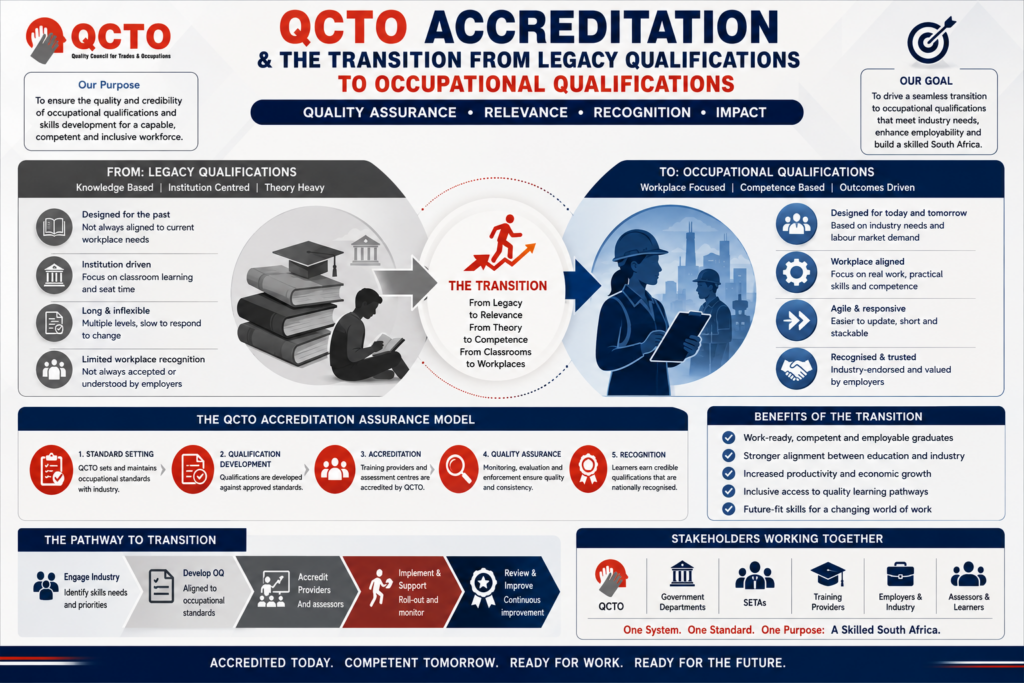
The Transition from Legacy to Occupational Qualifications
Why the transition is happening
Legacy qualifications were:
fragmented
inconsistent
not workplace‑aligned
outdated
unit‑standard driven
difficult to quality assure
Occupational qualifications are:
curriculum‑based
workplace‑integrated
nationally standardised
employer‑driven
easier to quality assure
aligned to real job roles
Current sector confusion
Providers are unsure about:
which qualifications are still valid
which SETAs still quality assure
how to migrate learning material
how to prepare for QCTO accreditation
how EISA works
how workplace learning must be structured
who certifies learners
This pillar resolves all of that.
The Roles of key Stakeholders
QCTO (Quality Council for Trades and Occupations)
Develops occupational qualifications
Accredits Skills Development Providers
Approves workplaces
Oversees assessment centres
Conducts External Integrated Summative Assessments (EISA)
Issues certificates
SETAs
NO LONGER accredit providers for occupational qualifications
Still manage DG funding
Still manage mandatory grants
Still manage workplace approvals for legacy qualifications
Act as Development Quality Partners (DQPs) or Assessment Quality Partners (AQPs) for certain qualifications
Support providers during migration
SAQA
Registers qualifications on the NQF
Ensures national standardisation
Maintains qualification records
Skills Development Providers (SDPs)
Must obtain QCTO accreditation
Must align learning material to occupational curricula
Must secure workplace learning partnerships
Must prepare learners for EISA
Employers / Workplaces
Provide workplace experience
Sign workplace approval agreements
Support learner competence development
Learners
Complete knowledge + practical + workplace components
Undergo EISA
Receive QCTO certification
Differences between Legacy & Occupational Qualifications
Legacy Qualifications (Unit Standard‑Based)
Managed by SETAs
Unit standards
Internal assessments
SETA certification
No external summative assessment
Limited workplace integration
Fragmented learning
Occupational Qualifications (Curriculum‑Based)
Managed by QCTO
Curriculum based – with a focus on Occupations
Knowledge + Practical + Workplace
External Integrated Summative Assessment (EISA)
QCTO certification
Strong workplace integration
National standardisation
Quality Assurance : SETAs vs QCTO
SETAs (Legacy)
Accredited providers
Monitored training
Verified assessments
Issued certificates
QCTO (Occupational)
Accredits providers
Approves workplaces
Oversees assessment centres
Conducts EISA
Issues certificates
Key Distinction
SETAs = internal assessment + legacy qualifications
QCTO = external assessment + occupational qualifications
National Qualifications Framework (NQF) Structure
NQF Levels (1–10)
Levels 1–4: General & Further Education
Levels 5–6: Higher Certificates & Diplomas
Levels 7–10: Degrees & Postgraduate
Where Occupational Qualifications Fit
Most occupational qualifications sit at:
NQF 2–4 (entry‑level trades)
NQF 5–6 (technicians, supervisors, specialists)
They are registered by SAQA and quality assured by QCTO.
Guides and Articles
QCTO Transition Strategy Guide
This guide provides an industry-agnostic, strategic blueprint to navigate the migration to the QCTO framework safely, ensuring compliance continuity and protecting your financial training investments
QCTO Accreditation & Compliance Guide
Provides institutions with a clear understanding of QCTO accreditation requirements and compliance expectations.
Curriculum Delivery & Workplace Learning Guide
Explains how occupational qualifications must be delivered according to QCTO curriculum requirements.
Assessment, Moderation & Certification Guide
Provides clarity on how assessment, moderation, and certification work within the QCTO system.
Frequently Asked Questions (FAQ)
- Are legacy qualifications still valid? Some are still active, but all are being phased out. Providers must migrate.
- Do SETAs still accredit providers? No. QCTO accredits providers for occupational qualifications.
- Who certifies learners? QCTO issues certificates after EISA.
- Do employers need approval? Yes — workplaces must be approved for occupational qualifications.
- Why is EISA required? To ensure national standardisation and competence.
Related Pillars
DG Administration
PFMA Compliance
Risk Management
Monitoring & Evaluation
Skills Planning
APP Alignment
Coming Soon
Additional QCTO guides and articles will be added as the Knowledge Hub expands.
Need Support?
Connect with us if you need additional information, guidance or support with understanding the QCTO migration from legacy to occupational qualifications, preparing for QCTO accreditation, implementation of Occupational qualifications, or other Quality Assurance related matters.