
APP Alignment
A complete guide to understanding, implementing, and managing Annual Performance Plan (APP) alignment within the PSET sector.
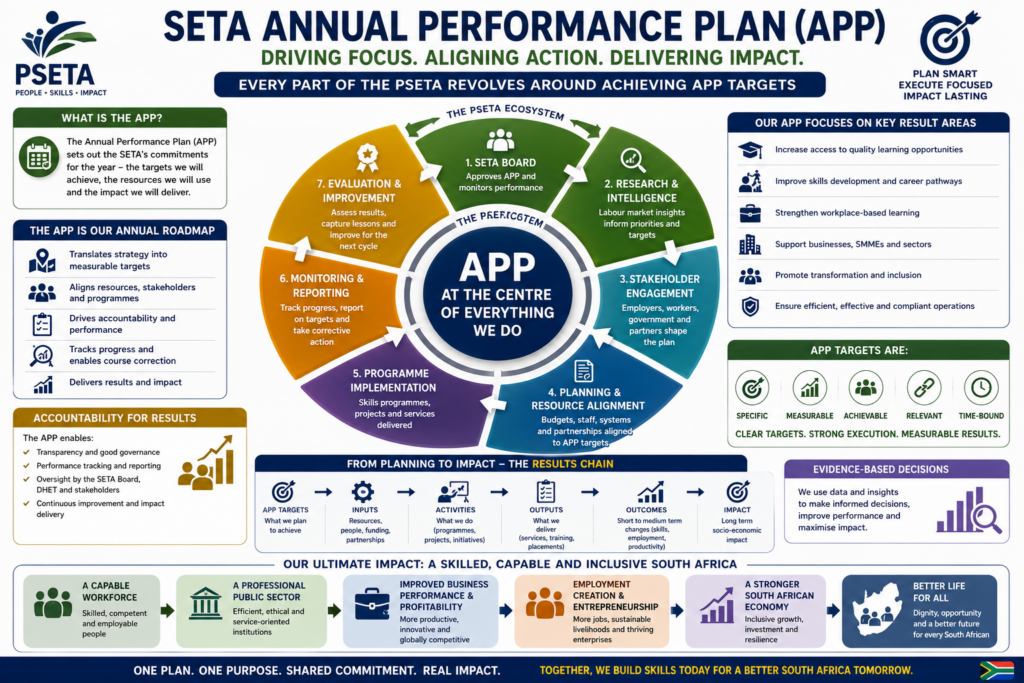
APP Alignment ensures that SETAs, TVET Colleges, Universities, and public institutions deliver measurable results that support national priorities. This pillar provides a structured, practical, and PFMA‑aligned overview of APP indicators, planning cycles, reporting requirements, and the challenges institutions face in meeting their APP targets — including how these challenges can be overcome.
What this pillar covers
This pillar explains the full APP ecosystem, including:
APP planning and alignment
Indicator development
Target setting
DG alignment to APP
M&E integration
PFMA and AG audit requirements
Institutional performance cycles
Challenges SETAs face in meeting APP targets
Solutions and best practices
Roles of SETAs, DHET, Providers, Employers, and Institutions
Why APP Alignment matters
APP Alignment ensures that institutions deliver measurable results, comply with PFMA, and demonstrate accountability for public funds.
Compliance
APP indicators must align with PFMA, Treasury Regulations, and AG audit expectations.
Governance
APP alignment strengthens oversight, transparency, and institutional credibility.
Performance
APP targets drive DG allocations, programme delivery, and institutional impact.
Key Components
Key Components
APP Planning Cycle Annual planning aligned to DHET and Treasury timelines.
Indicator Development Clear, measurable indicators aligned to institutional priorities.
Target Setting Realistic, evidence‑based targets informed by Skills Planning and M&E.
DG Alignment DG-funded programmes must support APP indicators.
Performance Monitoring Tracking progress through M&E systems.
Evidence Management Maintaining audit‑ready documentation for AG verification.
Reporting Requirements Quarterly and annual reporting aligned to PFMA.
Risk Integration Identifying risks that impact APP performance.
Institutional Accountability Clear roles and responsibilities for APP delivery.
Key Challenges in meeting APP Targets
1. Weak DG Administration
If DG projects are delayed, poorly monitored, or under‑performing, APP targets linked to learner enrolment, completion, or workplace placement cannot be met.
2. Poor Skills Planning
If SSP priorities are unclear or outdated, DG allocations may not support APP indicators.
3. Inaccurate or late WSP/ATR submissions
This affects sector data quality and leads to unrealistic APP targets.
4. Weak M&E Systems
Without proper monitoring, institutions cannot track progress or verify evidence.
5. Delayed QCTO accreditation
Providers cannot implement occupational qualifications, causing missed APP targets.
6. Poor internal controls (PFMA)
Weak controls lead to audit findings, irregular expenditure, and performance delays.
7. Insufficient workplace learning opportunities
Learners cannot complete workplace components, affecting completion targets.
8. Inadequate risk management
Risks are not identified early, causing performance failures.
9. Provider capacity issues
Providers lack resources, staff, or systems to deliver programmes at scale.
10. Data quality problems
Incorrect or incomplete data leads to inaccurate reporting and missed targets.
How to overcome APP Challenges
1. Strengthen DG Administration
Implement DG compliance checklists, commitments schedules, and evidence verification tools.
2. Improve Skills Planning
Use labour market analysis and SSP priorities to set realistic APP targets.
3. Enhance M&E Systems
Develop indicator matrices, monitoring tools, and evidence management systems.
4. Align DG to APP
Ensure DG-funded programmes directly support APP indicators.
5. Strengthen QCTO Migration
Support providers with curriculum alignment, workplace approvals, and EISA readiness.
6. Improve PFMA Internal Controls
Implement internal control frameworks and risk registers.
7. Expand Workplace Partnerships
Partner with employers to secure workplace learning opportunities.
8. Strengthen Risk Management
Integrate risk registers with APP indicators and mitigation plans.
9. Build Provider Capacity
Offer training, support, and quality assurance guidance.
10. Improve Data Quality
Implement data verification processes and digital reporting systems.
How Skills Planning Links to other Pillars
DG Administration
DG allocations must be based on SSP priorities and WSP/ATR data.
PFMA Compliance
Skills Planning supports budgeting, resource allocation, and performance reporting.
Risk Management
Skills gaps and labour market shortages are strategic risks.
QCTO Accreditation
Occupational qualifications must respond to sector skills needs.
Monitoring & Evaluation
M&E verifies whether training addresses identified skills gaps.
APP Alignment
Skills Planning informs APP indicators and targets.
Roles of Key Stakeholders
SETAs
Develop APP indicators
Align DG to APP
Monitor performance
Report to DHET and Treasury
Support providers and employers
DHET
Oversees APP alignment
Ensures national priority alignment
Reviews SETA performance
Skills Development Providers
Deliver programmes aligned to APP
Submit evidence
Support DG and QCTO processes
Employers
Provide workplace learning
Support learner completion
Submit workplace evidence
Institutions (TVETs, Universities)
Align programmes to APP
Report performance
Maintain evidence
APP Guides and Articles
APP Indicator Development Guide
Explains how institutions design measurable, PFMA‑aligned indicators that support accurate reporting and audit readiness.
APP Target Setting & Performance Planning Guide
Provides clarity on how institutions set realistic, evidence‑based targets and plan performance effectively.
APP Reporting & Audit Alignment Guide
Explains how institutions report performance and prepare for Auditor‑General performance audits.
Frequently Asked Questions (FAQ)
- Why do SETAs struggle to meet APP targets? Weak DG administration, poor M&E, inaccurate data, and provider capacity issues.
- How can APP performance be improved? Strengthen DG, M&E, PFMA controls, risk management, and workplace partnerships.
- Who is responsible for APP alignment? SETAs, DHET, Providers, Employers, and Institutions.
- How does APP link to DG? DG-funded programmes must support APP indicators.
- What are the reporting requirements? Quarterly and annual performance reports aligned to PFMA.
Related Pillars
DG Administration
PFMA Compliance
Risk Management
QCTO Accreditation
Monitoring & Evaluation
Skills Planning
Need Support?
Connect with us if you need additional information, guidance or support with aligning APP indicators, strengthening DG performance, or improving M&E and PFMA compliance